From Footman to Fortune: The Next Jack Trotter Could Be You
The original Gilded Age made railroad tycoons rich. But the fortunes built beyond the railroads might tell us more about the opportunities emerging today.
A few people own a whole lot, and a whole lot of people own very little. Sound familiar?
On Sunday, November 1, HBO’s The Gilded Age premiered its fourth season. And while the show follows some of New York’s wealthiest families during one of America’s greatest economic transformations, there’s another character whose story I’ve been thinking about: Jack Trotter.
Jack starts out as a footman in the Van Rhijn household. He isn’t born into wealth. He doesn’t have the educational advantages, money, or connections of the people living upstairs. But he has an idea, and he decides to do something with it. By the end of Season 3, that idea has changed his life.
And when I look at what’s happening in our economy today, I can’t help thinking about Jack. We’re living through another period of enormous economic change. Just like the original Gilded Age, some people are accumulating extraordinary fortunes while others are struggling to survive. But there’s something else happening that deserves our attention.
Before the Gilded Age, There Was the Industrial Revolution
Beginning in the late eighteenth century, the Industrial Revolution started changing how people produced goods, transported materials, and conducted business. Factories expanded, machines transformed manufacturing, and steam power and railroads eventually made it possible to move people and goods farther and faster.
In the United States, industrialization developed alongside an economy still heavily dependent on agriculture. In the South, much of that agricultural wealth was built through chattel slavery. These systems overlapped. Industrialization didn’t suddenly begin when slavery ended, but emancipation, railroad expansion, and manufacturing growth helped transform the country’s economy.
The first transcontinental railroad was completed in 1869. According to the Library of Congress, approximately 170,000 miles of railroad track were added across the United States between 1871 and 1900.
Think about what that meant. Manufacturers could reach customers in other parts of the country. Farmers could ship their products to distant markets. New towns developed along railroad routes, and businesses could operate on a scale that hadn’t been possible before.
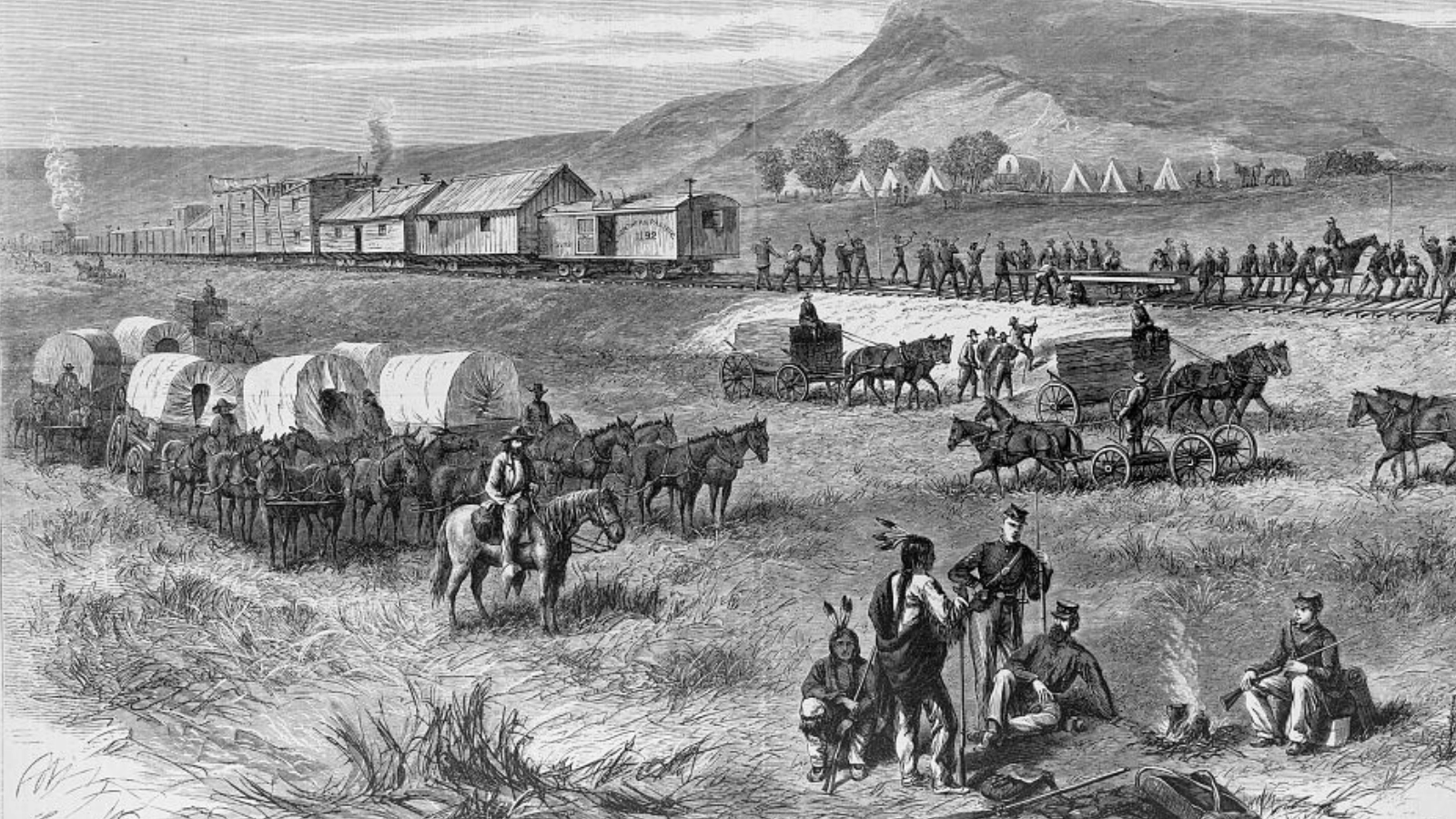
1875 RAILROAD CONSTRUCTION ENGRAVING
Railroad building on the great plains, Alfred R. Waud, 1875. Wood engraving. Library of Congress. View original archive record
The Vanderbilts built railroad empires. Andrew Carnegie accumulated wealth through steel. John D. Rockefeller built his fortune through oil. These were some of the men who became synonymous with the Gilded Age, when tremendous wealth was concentrated among a relatively small group of industrialists.
But the Gilded Age wasn’t exactly wonderful for everybody. Far from it. Factories employed children, workers endured dangerous conditions and long hours, and wages were often low. Railroad expansion also came at the expense of Indigenous communities whose lands were taken as the country expanded westward. Workers organized, unions grew, and strikes spread as people fought for safer workplaces and better pay.
Investors also poured money into railroad companies because everybody wanted a piece of the action. Companies borrowed heavily to build new routes, sometimes expanding faster than demand could support. In 1873, the failure of Jay Cooke & Company, which had invested heavily in the Northern Pacific Railway, helped trigger a financial panic. Businesses collapsed, investors lost money, and the country entered a prolonged depression.
But here’s the thing about the railroads. Despite the financial crisis, the tracks didn’t disappear. Trains continued moving goods, connecting cities, and opening new markets. The railroad companies were only part of the economic story.
Everybody Is Betting on the New Railroads
Now look at what’s happening today. The internet, cloud computing, and artificial intelligence have changed how people communicate, work, and conduct business. Technology companies are pouring extraordinary sums into data centers, semiconductors, computing power, and software, particularly to support AI.
And just last Friday, October 30, Wall Street experienced a major technology selloff as investors questioned whether companies would generate sufficient returns from that spending. Reuters reported that the Nasdaq Composite fell 2.86%, while the semiconductor index dropped 7.2%. Earlier in the week, Reuters also reported that China’s STAR50 index, which includes major AI and semiconductor companies, had fallen approximately 40% in less than four months, wiping out around $480 billion in market value.
Does any of that sound familiar? During the original Gilded Age, investors understood that railroads were transforming the economy. They were right about the technology. But that didn’t mean every railroad investment would make them wealthy.
And AI is raising serious questions about jobs, compensation, and what happens when technology changes the amount of human labor companies need. The Industrial Revolution showed us that economic transformation can create enormous wealth and tremendous hardship at the same time. We have to pay attention to both.
But I keep coming back to another question. What happened to the people who weren’t investing in railroad stocks? What about the businesses that became possible because the railroads existed?
You Didn’t Have to Own the Railroad
Take Fred Harvey. In 1876, Harvey began operating a restaurant at a Santa Fe railroad depot in Topeka, Kansas. He had worked in the railroad industry and knew the food available to travelers was often terrible. People needed somewhere decent to eat, and he built a business around that need.
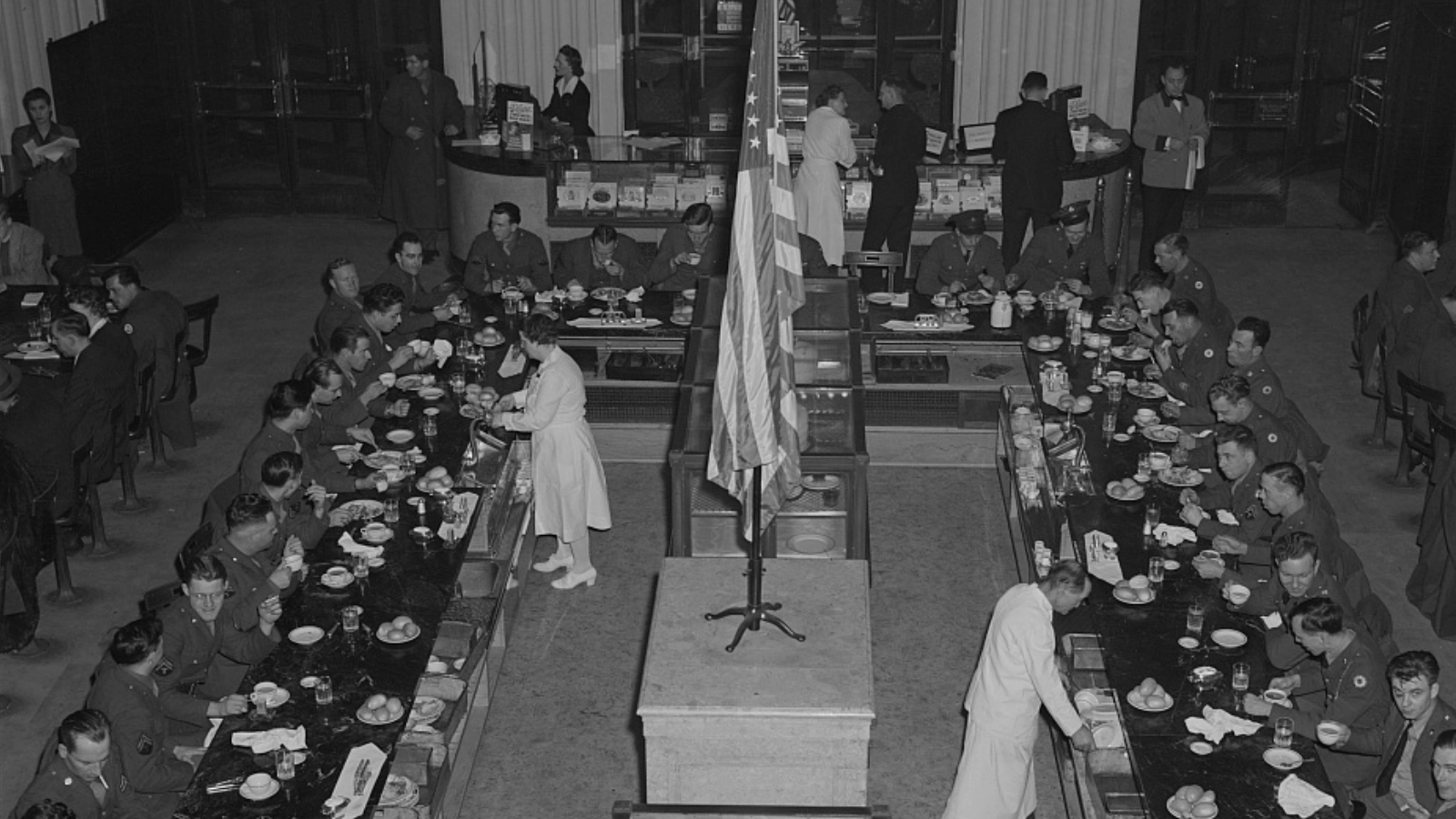
1943 HARVEY HOUSE RESTAURANT PHOTOGRAPH
A Fred Harvey restaurant at Chicago Union Station, photographed by Jack Delano in 1943. This later image illustrates the restaurant network Harvey began building in 1876. Library of Congress. View original archive record
According to the Kansas Historical Society, within seven years Harvey operated seventeen restaurants along the railroad’s main line. By 1901, his company had grown to forty-five restaurants and twenty dining cars across twelve states. Harvey didn’t own the railroad. He built a company serving the people traveling on it.
Now look at Montgomery Ward. In 1872, Aaron Montgomery Ward started selling products by mail-order catalog. As railroad networks expanded, businesses like Montgomery Ward and, later, Sears could reach customers living far from major cities. The Smithsonian explains how rail transportation helped make that kind of national commerce possible.
They weren’t building railroad tracks. They recognized what an existing transportation network could make possible. And that brings me back to Jack Trotter.
From Footman to Fortune
Jack is a footman who loves figuring out how clocks work. He comes up with an idea for improving an alarm clock, then works to develop it. But having an idea and turning it into something valuable are two different things.
He needs money to develop his invention and pursue a patent, so he turns to the people around him. Some of the servants he works alongside contribute funds. With help from Bannister, the household’s butler, he gains access to people who can help him with the patent process. And eventually he partners with Larry Russell, whose family connections and business experience open another door.
In Season 3, Jack and Larry sell the clock patent for $600,000 and split the proceeds. Jack receives $300,000. A footman becomes a wealthy man.
What interests me isn’t only the money. Jack started with an idea, took action, got support from his community, and kept going until he had created something valuable. He didn’t begin with every resource he needed. But he did something with what he had, and people helped him along the way.
That’s something more creatives need to hear. You don’t need every connection, every dollar, or a perfect plan before you begin. The next step can lead you to people and opportunities you couldn’t reach from where you started.
Look at What You’re Holding
During earlier economic eras, owning land, factories, equipment, transportation infrastructure, and natural resources gave people control over the assets used to produce economic value. But today, you can start with that thing you’re holding, the one you’re reading this article on. Your phone or your computer.
You can build a website, publish a book, sell a product, reach customers across the world, or start a business around an idea. Many of the tools available are free or relatively inexpensive. The internet changed access to information and distribution. Social media changed how people could reach audiences. Digital commerce made it easier to sell without a physical storefront, and AI is expanding what individuals and smaller businesses can do with fewer resources.
But you don’t even have to use AI. That’s the point. We’ve been watching people use these technologies to build businesses for years.
Michelle Phan began making makeup videos on YouTube before co-founding Ipsy, a beauty subscription company that reached a valuation exceeding $500 million in 2015, according to Forbes. Issa Rae created The Mis-Adventures of Awkward Black Girl and distributed it independently on YouTube. That helped open the door to Insecure on HBO, but she didn’t stop at a television show. She went on to build HOORAE, a media company spanning film, television, music, and other creative ventures.
Their original work helped them reach audiences, but the opportunities didn’t stop at content. And the same tools are opening routes into retail, education, software, design, publishing, and services. The creator economy is one visible part of a much broader change in commerce.
The Name of the Game Is Ownership
Go beyond attention. For years, everybody has been focused on views, likes, followers, and engagement. How many people watched your video? How many subscribers do you have? Did your post go viral? Okay. But what are you actually building?
You can spend years building an audience on social media, and at any moment your access to that audience could disappear. Your account could be suspended, the algorithm could change, or the platform could stop showing your work to the people who followed you. The company controls the algorithm. The company controls distribution. And when you depend entirely on that platform, you depend on somebody else’s business to keep yours running.
Build the company. Build that email list. Create the product. Develop your intellectual property. Give customers and subscribers a direct way to find you beyond social media. Followers aren’t the same thing as a business, and going viral isn’t the same thing as building wealth.
The name of the game is ownership. Content creation can be the stepping stone, but what comes after it? What can you build that has value beyond the platform where you started?
Jack developed an invention someone was willing to pay for. Michelle Phan and Issa Rae used creative work to reach audiences and then built businesses beyond those platforms. The opportunity extends to writers, designers, artists, educators, and people with business ideas they haven’t acted on yet. What matters is recognizing what the tools make possible and deciding to build something of your own.
VISIONS / WHAT WE SEE
The name of the game is ownership.
This Is What I See
When I look back at the Industrial Revolution and the Gilded Age, I see tremendous economic suffering. People lost jobs and savings, workers fought for protections, and a small group of industrialists accumulated extraordinary fortunes. But I also see new industries, businesses, and opportunities for upward mobility that hadn’t existed in the same form before. Some people built wealth. Many others remained excluded.
And I believe we’re at the beginning of an even greater opening. Unlike the original Gilded Age, when opportunities for upward mobility were available to a much smaller share of the population, the internet has made it possible for far more people to enter markets, reach customers, and try to build businesses of their own.
We’ve already seen the beginnings of that change. People are developing intellectual property, creating products, and growing companies through technologies they don’t own or control. I believe more people could become owners of the value they create, and that this could lead to one of the greatest expansions in the distribution of newly created wealth in history.
That distinction matters. Creating income and building wealth aren’t necessarily the same thing. If you create something valuable, you should be thinking about how much of it you own and what you can carry with you if a platform changes.
Fred Harvey saw hungry railroad passengers. Montgomery Ward saw customers he could reach beyond the storefront. Jack Trotter saw what he could do with a clock. Each recognized something becoming possible and acted on it.
And now I’m looking at the people who have ideas but think they don’t have the money, connections, or institutional backing to pursue them. The next great business opportunity might not come from owning the technology everybody is talking about. It might come from seeing what that technology makes possible and building something people need.
Everybody’s betting on AI. I’m betting on people and what they can build.
Keep up with what’s happening at Lily House Studio. Get the latest VISIONS articles, updates on what we’re building, and creative opportunities worth knowing about through Letters from the House, our weekly newsletter.